3D Honeycomb Bike Saddle: Lightweight Comfort & Shock Absorption

Lightweight 3D Honeycomb Bike Saddle with Shock Absorption: Comfort for Longer Rides
A supportive saddle can change how a bike feels on rough pavement, gravel, and long commutes. A 3D honeycomb design aims to spread pressure across a wider surface while absorbing small bumps that can lead to soreness. This guide explains what a lightweight honeycomb saddle does differently, who it tends to suit, how to set it up for day-one comfort, and what to evaluate so the “shock absorption” feel actually shows up on real roads. For more guidance, see Development of an Ergonomic Additively Manufactured Modular ….
What a 3D honeycomb saddle changes compared with traditional padding
Traditional saddles usually rely on foam or gel that compresses under load. That can feel plush at first, but on longer rides it may pack down, concentrate pressure, or create extra movement that leads to chafing. A 3D honeycomb saddle approaches comfort differently by using a flexible structure rather than thick padding. For further reading, see Designing Metallic Microlattices for Energy Absorber Applications.
- Multi-direction flex: Honeycomb structures can deform in more than one direction, helping take the edge off repetitive, high-frequency impacts (think pavement seams, chipseal buzz, and gravel chatter).
- Ventilation: Many honeycomb designs are open-cell, which encourages airflow and can reduce heat buildup on longer rides or indoor sessions.
- Different pressure feel: Instead of a “sink-in cushion,” the sensation is often a more supportive, spring-like platform that spreads load across a broader area.
- Lightweight benefits (within reason): Lower saddle weight can be nice for climbing and acceleration, but comfort is far more dependent on correct width, shape, and setup than on saving grams.
Who it’s best for
Honeycomb saddles can work across a range of riding styles, especially when discomfort is driven by vibration and pressure concentration rather than the need for extreme softness.
- Commuters: Helpful for smoothing road seams and pothole chatter during stop-and-go riding and frequent remounts.
- Fitness riders: Supportive for 30–120 minute rides where numbness can become noticeable if the saddle doesn’t match sit-bone width.
- Gravel and mixed-surface riders: Can reduce vibration buildup on washboard sections and rough chipseal.
- Spinning/indoor riders: Airflow and pressure distribution can improve comfort during steady efforts where heat and sweat are common.
- Not always ideal for: Riders who require a very specific cut-out shape for medical reasons, or those who need a very wide platform. Fit still comes first.
Key comfort features to evaluate before buying
Quick fit check: match saddle style to riding posture
| Riding posture | Typical handlebar height vs. saddle | What to prioritize | Common mistake |
|---|---|---|---|
| Upright/comfort | Higher or similar | Wider support, stable platform, softer vibration damping | Choosing a narrow race-style saddle that concentrates pressure |
| Moderate lean/fitness | Slightly lower | Balanced width, relief channel, controlled flex | Overly thick padding that causes rocking and chafing |
| Aggressive/road | Lower | Firm support, effective relief zone, shape that supports forward rotation | Too-wide saddle that interferes with pedaling |
Setup tips to get the shock-absorbing benefits
- Start level: Use a phone level app on the main sitting area (not the upturned tail). Adjust 1–2 degrees nose-down only if pressure persists. Too much downward tilt causes sliding and extra hand pressure.
- Set saddle height carefully: A saddle that’s too high can cause hip rocking, increasing friction and soreness. If you’re unsure, compare your setup to established guidelines like BikeRadar’s saddle height walkthrough: https://www.bikeradar.com/advice/fitness-and-training/how-to-set-saddle-height/.
- Dial in fore-aft: Aim for stable pedaling where your knees track naturally and you’re not constantly pushing yourself back into position. Micro-adjustments can eliminate hot spots.
- Check cleats and stance width: Foot position affects hip rotation and pressure distribution. If discomfort persists despite saddle tweaks, misaligned cleats can be the real culprit.
- Tighten rails to spec: Use a torque wrench if possible. Over-tightening can damage rails; under-tightening can lead to slipping.
Care, durability, and real-world expectations
Product spotlight: Lightweight 3D Honeycomb Bike Saddle with Shock Absorption
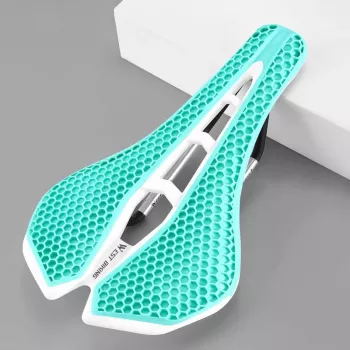
If the goal is comfort without bulky padding, the Lightweight 3D Honeycomb Bike Saddle with Shock Absorption is designed around a 3D honeycomb structure that helps reduce vibration while spreading pressure more evenly. It’s a strong match for commuting, fitness riding, and mixed-surface routes—especially when you confirm the width works for your sit bones and your posture matches the saddle’s intended support zone.
At-a-glance details
| Item | Details |
|---|---|
| Name | Lightweight 3D Honeycomb Bike Saddle with Shock Absorption |
| Price | 46.01 USD |
| Availability | In stock |
| Product page | View product |
Comfort add-on for safer long rides
Comfort helps you stay on the bike; visibility helps you get home safely. If you ride at dawn, dusk, or in traffic, pairing a comfort-focused saddle with reliable lighting is a practical upgrade. The USB Rechargeable Super Bright Bike Headlight & Taillight Set is an easy add for commuting and mixed-surface riding where changing light conditions are common.
FAQ
Is a honeycomb saddle comfortable for long rides?
It can be, especially when the saddle’s width and shape match your sit bones and riding posture. Honeycomb designs often reduce vibration and spread pressure, but an incorrect fit or poor tilt can still cause numbness or chafing.
Should a bike saddle be level or tilted?
Start level, then fine-tune in small steps—about 1–2 degrees—based on pressure and stability. Too much nose-down tilt often leads to sliding forward and extra load on your hands and shoulders.
How do you know if a saddle is too wide or too narrow?
A too-narrow saddle tends to create concentrated sit-bone pressure and can contribute to numbness, while a too-wide saddle commonly causes inner-thigh rubbing during pedaling. Measuring sit-bone width (or using a shop fitting tool) is the most reliable way to choose the right size.










Leave a comment