Creative AI Problem-Solving Ebook for Innovators
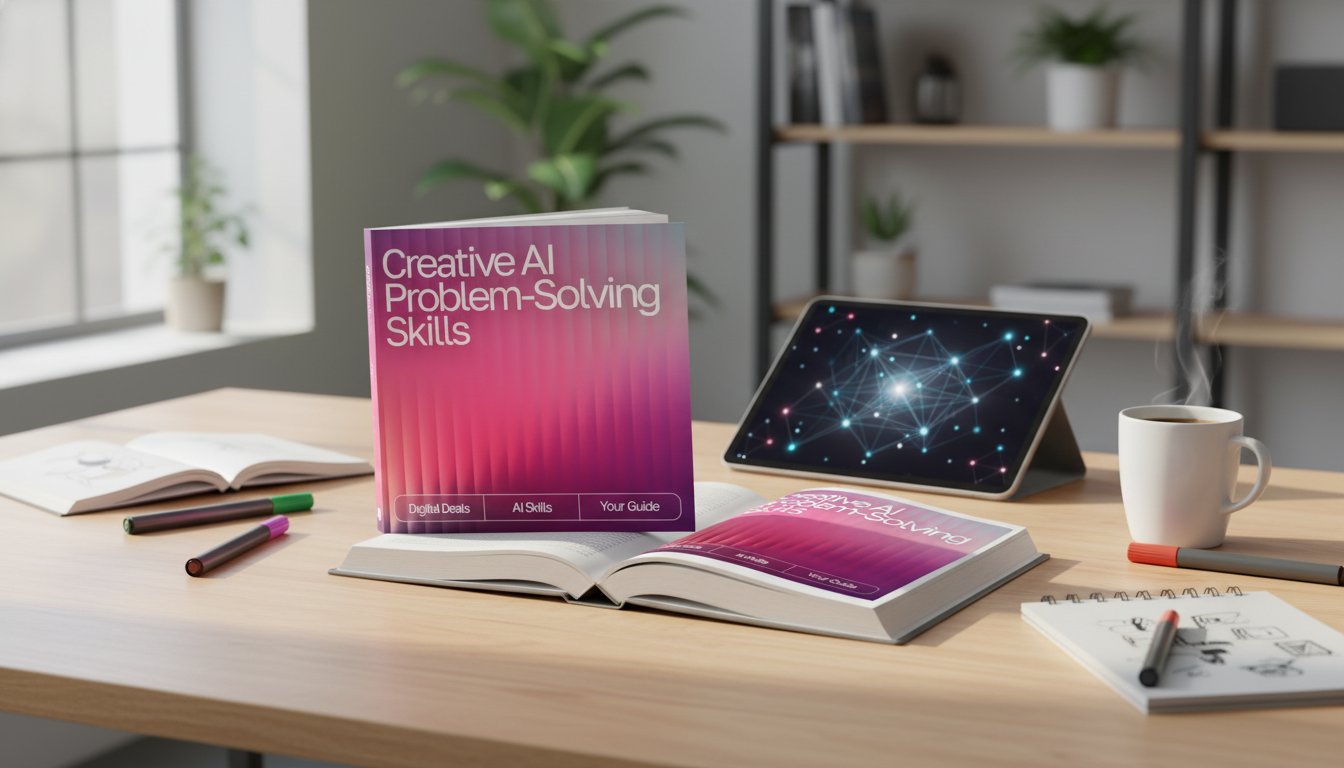
Creative AI Problem-Solving Skills Ebook: A Practical Digital Guide for Innovators, Creatives & Entrepreneurs
Creative problem-solving gets easier when ideas can be generated, tested, and refined quickly. This digital ebook focuses on the AI skills that help innovators, creatives, and entrepreneurs break through stuck points—turning vague challenges into clear options, stronger concepts, and actionable next steps without losing the human judgment that makes work original.
If you want a repeatable way to move from “not sure what to do next” to a clean plan you can execute, the Creative AI Problem-Solving Skills Ebook is designed to be used while you’re actively working—not saved for someday.
What “creative AI problem-solving” looks like in real work
Good AI-assisted problem-solving isn’t about chasing a single perfect answer. It’s about building a reliable thinking loop that keeps you moving—especially when requirements are fuzzy, stakeholders disagree, or time is tight.
- Turning messy challenges into well-formed questions and constraints
- Generating multiple directions (not just one “best” answer) to avoid tunnel vision
- Spotting patterns, gaps, and risks earlier using structured exploration
- Using AI as a thinking partner for iteration, reframing, and synthesis
- Balancing speed with quality: when to diverge, when to converge, when to validate
Think of it like having a fast sketchpad for reasoning: you explore broadly, then narrow down with intention—using your experience and taste to decide what actually fits the real-world context.
Who this ebook supports and the outcomes to expect
- Innovators: quicker concept-to-prototype cycles and stronger rationale for decisions
- Creatives: broader ideation, clearer creative briefs, and improved critique loops
- Entrepreneurs: sharper positioning, clearer offers, and better prioritization under uncertainty
- Students and career-switchers: transferable AI-assisted thinking habits for portfolio projects
- Teams: shared language for exploring options and aligning on next steps
Instead of relying on inspiration to strike at the right moment, you build a repeatable method for turning pressure into progress—without flattening your voice or taste.
Core skills covered: the problem-solving loop
The ebook centers on a practical loop you can reuse across creative, business, and operational problems. Each stage has a clear purpose and a tangible output, so you can tell when you’re moving forward.
- Define: clarify the real problem, stakeholders, constraints, and success criteria
- Reframe: generate alternative problem statements to reveal hidden opportunities
- Diverge: create a wide range of solutions, metaphors, and approaches
- Converge: evaluate options with lightweight scoring and trade-off thinking
- Validate: test assumptions, anticipate failure modes, and plan small experiments
- Document: capture learnings so future projects start smarter, not from scratch
Problem-Solving Stages and Useful Outputs
| Stage | Best Use | Example Output |
|---|---|---|
| Define | Reduce ambiguity and set boundaries | One-sentence problem statement + success criteria |
| Reframe | Unlock new angles and avoid obvious solutions | 3–5 alternative framings (cost, time, audience, value) |
| Diverge | Generate variety and novelty | 10+ concept directions with quick pros/cons |
| Converge | Choose a direction with clear reasoning | Shortlist ranked by impact, effort, and risk |
| Validate | Pressure-test before investing heavily | Assumption list + small experiment plan |
Practical ways to apply the ebook across projects
The loop is intentionally flexible. It works for “blank page” creative starts, mid-project pivots, and late-stage decisions where you need to reduce risk.
- Content and branding: create message maps, tagline options, and audience-specific angles
- Product and UX: map user pains, generate feature hypotheses, and test prioritization
- Operations and process: identify bottlenecks, propose alternatives, and draft SOP improvements
- Education and learning: turn topics into study plans, examples, quizzes, and reflection prompts
- Personal creativity: explore themes, constraints, and variations to develop a distinctive style
For design-heavy ideation and visual exploration, it also pairs naturally with Dream Spaces with AI, which focuses on inspiration, visualization, and transforming a concept into a clearer look and feel.
Quality control: how to keep outputs original, accurate, and useful
AI can speed up thinking, but quality still depends on how you steer the work and how you verify what matters. A strong process makes results feel less generic and more “you.”
- Use constraints intentionally: audience, tone, format, and non-negotiables reduce generic results
- Ask for alternatives and counterarguments: explore what could be wrong, not just what sounds right
- Separate brainstorming from decision-making: generate first, judge second
- Verify factual claims: check reliable sources when the stakes are high
- Maintain a human final pass: protect voice, ethics, and context-sensitive choices
For a grounded approach to risk and responsibility, consult frameworks like the NIST AI Risk Management Framework (AI RMF 1.0) and the OECD Principles on Artificial Intelligence. If you want a practical lens on keeping systems aligned with human needs, explore Stanford HAI — Human-Centered AI.
A simple workflow to build the habit in 20 minutes
Consistency beats intensity. This quick routine is a useful “minimum viable” version of the loop—perfect for daily practice or when you’re short on time.
Digital download details and what comes next
If you want a practical system you can return to whenever you hit a wall, start with the Creative AI Problem-Solving Skills Ebook, then build a small library of proven reframes, tests, and decision notes that make each new project faster and clearer.
FAQ
Is this ebook better for beginners or experienced creators?
It’s structured so beginners can follow a clear loop and get quick wins, while experienced creators can use it as a repeatable framework for deeper iterations, stronger critique, and cleaner decision rationale.
Do these techniques work without technical or coding skills?
Yes. The focus is on thinking habits and process—clarifying, exploring, evaluating, and validating—so no coding is required to apply the methods to everyday creative and business challenges.
How can AI help without making the work feel generic?
Use strong constraints, request multiple distinct directions, add personal context, and do a human editorial pass to protect voice, nuance, and originality before anything is finalized.










Leave a comment